Tuesday, August 20, 2013

Back at the Presa

Extremely high water levels at the Presa showed that this has been a good rainy season.  These levels bode well for the wildfowl that will arrive here in another month or so.  The lack of muddy edges, though, meant that there weren't a great deal of waders to be found.  Just Killdeers, Spotted Sandpipers and a bonus, this overflying Long-billed Curlew.


In the scrub it is too early for winter migrants, so the main focus was on common breeding birds such as Cactus Wren and Inca Doves.


Tuesday, July 9, 2013

Birding Texas - South Padre Island

The Birding Center at South Padre Island was a treasure trove of Texan specialities - all providing great views and including several lifers for me.  Things were hot on the heron front, with Great Blues and Louisiana Herons particularly visible, as well as Yellow-crowned Night Herons, Great and Snowy Egrets, Green Herons and numerous Least Bitterns.


Great Blue Heron

Louisiana Heron

Yellow-crowned Night Heron


Least Bittern
 These herons fed alongside numerous White Ibis, whilst in the vegetation scuttled a Clapper Rail.  I was expecting this skulker to be difficult to find, but it fed regularly in the open, even walking underneath us on the boardwalk at one stage.

Clapper Rail
On the areas of water, were some more bonuses.  An incredibly tame Pied-billed Grebe (one of 8), the abundant Black-bellied Whistling Duck and the localised Mottled Duck.


Pied-billed Grebe
Mottled Duck
Black-bellied Whistling Duck
 Lying off the coast, South Padre Island also had some sea-going specialities.  First, a tern bonanza including American Black Tern, Least Tern, Caspian Tern, Royal Tern and Sandwich Tern.

American Black Tern

Royal Tern
Also in the skies were Magnificent Frigatebirds and Brown Pelicans.

Not the best time of year for waders, but we still came across Willets, Killdeers, breeding Black-necked Stilts, a pair of American Oystercatchers and this oddly-behaving Wilson's Plover.

Wilson's Plover, what's he up to?


Birding Texas - Bentsen Rio Grande Valley State Park

I've had a week in McAllen, Texas, and the opportunity to take in a few Texan Gulf Coast specialities.  First stop was the Bentsen Rio Grande Valley State Park, which is part of the 'World Birding Center' chain of sites down here.  The place was really well run, with a great visitor center, plenty of birding trails and hides, and a number of feeding stations which, in winter, would be absolutely brimming with birds.

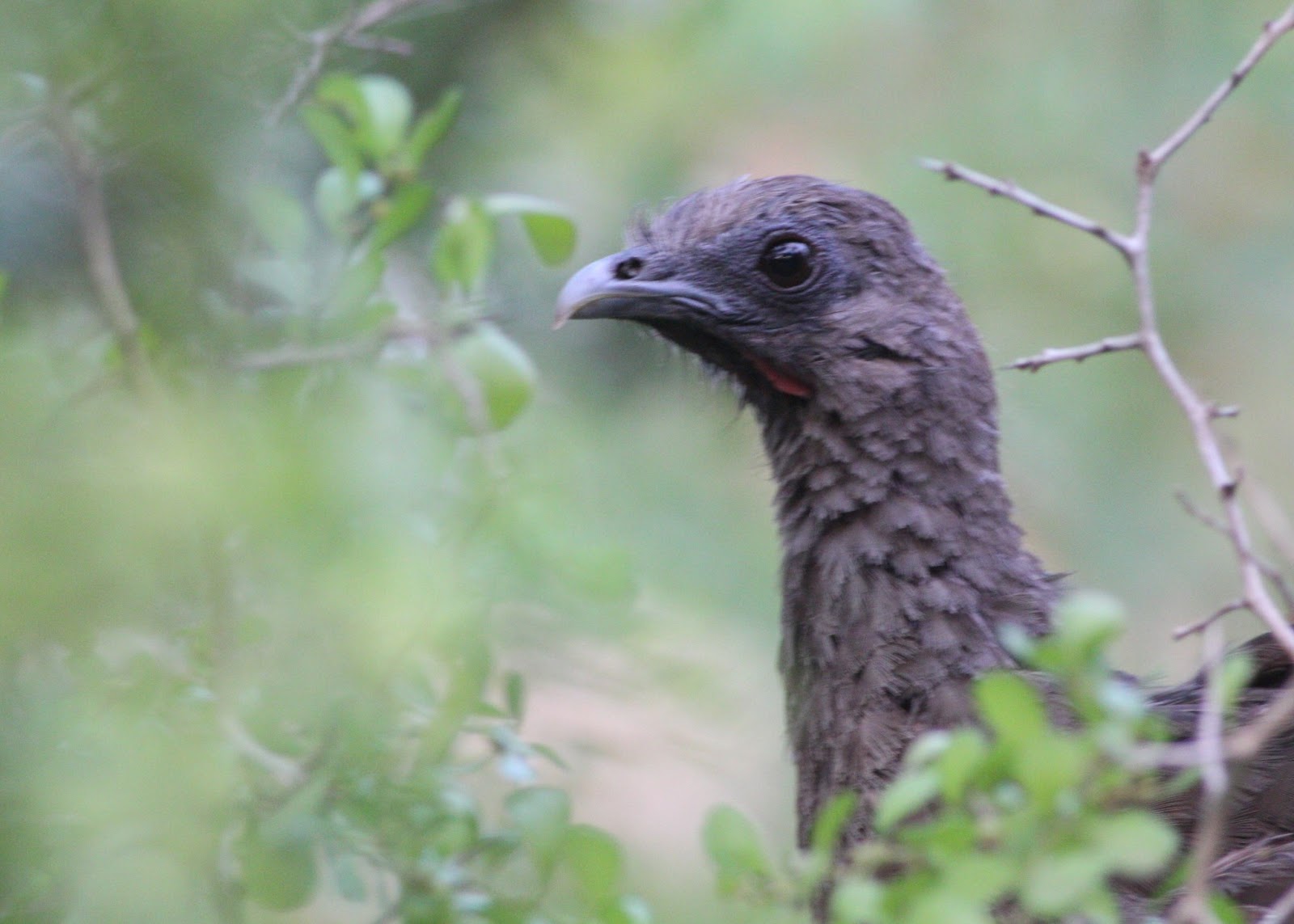
Although summer is arguably the worst time of year to visit here, we still came across a number of excellent birds.  Around the visitor center, for example, there were a number of parties of feeding Plain Chachalacas...


Plain Chachalaca
Surprisingly in the trees, we also saw many of the odd Black-bellied Whistling Ducks.  This one was only too happy to pose for a photo.


Sharing the trees with the ducks were birds such as Northern Cardinals, countless Golden-fronted Woodpeckers and Northern Mockingbirds, Green Jays, Olive Sparrows and Groove-billed Anis


Northern Cardinal
Green Jay
 In the undergrowth, we encountered Curve-billed and Long-billed Thrashers, Mourning, White-tipped, White-winged and Inca Doves, Ladderback Woodpeckers, an Altamira Oriole, and an interesting case of a Hooded Oriole (below) feeding a young Bronzed Cowbird.  The Cowbirds are notorious nest parasites, and in this instance, the Oriole believed the Cowbird was from its own brood.

Hooded Oriole 
 Under a bridge on the reserve, there were Cave Swallows, Purple Martins, Red-winged Blackbirds and a Black Phoebe, whilst on the wires were some more Gulf Coast Specialities - Scissor-tailed Flycatchers and Couch's Kingbirds.  On the visitor center feeding stations were Buff-bellied Hummingbirds.

Oh, hold on.  There's one more character that I've missed out....


Yep, that's right, Wily Coyote was in town.  Watch out Roadrunner.  

Sunday, June 30, 2013

El Centenario in the summertime

The Summer survey at the Presa came right at the end of the dry season.  As a result of the long period of dry weather, there was very little water in the reservoir, and very few birds as well.  In fact, apart from a couple of adult Mexican Ducks, all that was present were about 6 breeding pairs of Killdeers.

A few weeks later, after some very heavy storms, though, and things were brightening up.  A lot of fresh water in the reservoir had attracted some decent birds.  Perhaps the best was this distant Roseate Spoonbill bombing over the water.  The same one that has been knocking around all winter, or perhaps a different individual?


On the water was a surprisingly good variety of ducks.  12 Northern Shoveler (non-breeders), as many Ruddy Ducks and Mexican Ducks and best of all, 2 adult Fulvous-Whistling Ducks.  On the wader front, there were 5 adult American Avocets in prime summer plumage and some Black-necked Stilts and Killdeers.

A Peregrine oversaw proceedings.

San Joaquin, Sierra Gorda

Been a bit slow on the blog posts recently - here's some photos from San Joaquin, a town in the south of the Sierra Gorda range, and just 90 minutes from Tequisquiapan.  As you climb into the mountains here, the habitat becomes more forested, and the bird life changes accordingly.

Below - American Robin, Crescent-Chested Warbler and juvenile Mexican Jay.


One good spot at San Joaquin is Aventura Park, where you can stay in cabanas, and walk around some of the tracks in the forest.  As well as the above, we saw Painted Redstarts, Audubon's Orioles, Yellow-eyed Juncos, White-eared hummers, Blue-throated Hummers, Canyon Towhees, Ruby-crowned Kinglets and many more..

We had a day at Grutas las Herrera.  Here, there were Rufous-crowned Sparrows, nesting House Wrens, nesting Pine Flycatcher, Eastern Wood-Pewees, Curve-billed Thrashers..


Friday, May 10, 2013

Birding Ixtapa

Got out for a few morning's birding during a lads long-weekend in Ixtapa and Zihuatanejo recently.  We were staying by the Marina in 'Porto Ixtapa' and around the complex, I had Streak-backed Orioles, Olive Sparrows, Citreoline Trogons, Rufous-naped Wrens, Great-tailed Grackles, Grey-breasted Martins, Barn Swallows, Mangrove Swallows, West Mexican Chachalacas, Great Kiskadees, Social Flycatchers, Tropical Kingbirds, Cinnamon Hummingbirds, Orange-breasted Buntings and Blue Buntings.

Olive Sparrow

Rufous-naped Wrens

Streak-backed Orioles

Things were great at dawn at Playa Linda.  In the Crocodile Pen, there were breeding Roseate Spoonbills, Green Herons, Yellow-crowned Night-herons, Snowy Egrets and Boat-billed Herons. Nearby, there were breeding Wood Storks.  Along the beach and offshore, we saw Brown Pelicans, Magnificent Frigatebirds, Brown Boobys, Royal Terns, Least Terns, Willets, Neotropic Cormorants and Laughing Gulls.

Brown Pelicans at Playa Linda


Neotropic Cormorant

Roseate Spoonbill

Willet

Roseate Spoonbill


Green Heron 

Yellow-crowned Heron
Wood Stork

Mick Dundee

Great-tailed Grackle pair


After the beach, I walked up into the hills behind Playa Linda.  Here, I found Northern Cardinals, White-bellied Wrens, the endemic and beautiful White-throated Magpie Jays, Hooded Orioles, Yellow Warbler, Zone-tailed Hawks, Black Vultures and Turkey Vultures and many of the birds also seen at Porto Ixtapa.

White-throated Magpie Jay

Friday, May 3, 2013

Santa Catarina

I checked out this site on an evening stroll yesterday.  It's located 20 minutes north of Queretaro, and some fantastic species have been reported here, such as Wood Stork (see http://birdingmexico.blogspot.mx/).


Lots of good muddy areas held Least Sandpipers, a few Baird's Sandpipers, 1 Lesser Yellowlegs, some American Avocets, many Killdeer and this sublime Semipalmated Sandpiper.  Didn't check all waders properly, I can see however how this place holds the potential to attract really good birds.

Not many duck left now in Queretaro, most having returned to breed in North America, but I did see a few Northern Shoveler, Ruddy Duck (resident), Mexican Duck (resident) and Blue-winged Teal.

Also, still c.70 American White Pelicans loafing around.  Plenty of Neotropic Cormorants and White-faced Ibis too, as well as Great Egrets, Snowy Egrets and Cattle Egrets, and the odd late Black-crowned Night Heron.

Migging Yellow-rumped Warblers abounded on the edges of the lake, and Barn and Bank Swallows were joined by some Nighthawk at dusk hawking for insects.

All in all, not a bad evening.  Certainly a place I will return to.
BUBO Listing www.bubo.org