Monday, December 2, 2013

MEGA - Anhinga at Presa de la Constitucion

First visit to Presa de la Constitucion near San Gil for a few months, and it was well worth it to find an ANHINGA. These Cormorant-like birds are fairly common in coastal areas of Mexico, but aren't generally found inland.  Definitely represents a very rare bird for the state of Queretaro, particularly the lower half of the state.

Anhinga
Extremely high water levels here meant that the only waders I found were a few Spotted Sandpipers and a Killdeer.  At this time last year, the shoreline was at least half a mile further in.

A few Neotropic Cormorants allowed for an interesting comparison with the Anhinga.  Both species were sharing the tree tops with a reasonable amount of Great Blue Herons, Great Egrets and a few Crested Caracaras.  On the water, small flocks of Mexican Ducks and Northern Pintails, and some Ring-billed Gulls.

The bushes and trees around the lake were full of critters.  Plenty of Yellow-rumped Warblers and at least 10 Common Yellowthroats.  Some pishing in the woods by Fiesta Americana brought in 2 Orange-crowned Warblers,  1 Wilson's Warbler, 1 Cassin's Vireo, 8 Blue-grey Gnatcatchers and at least 5 Ruby-crowned Kinglets.


Ruby-crowned Kinglet

Common Yellowthroat
Other birds - Bewick's Wren, Marsh Wren (2), Abeille's Oriole  (20+), Hooded Oriole, Curve-billed Thrasher, Blue Grosbeak.

It's a big old lake at the moment.  I'm sure a full walk around the perimeter  would yield a huge day list, and potential rarities.

Saturday, November 30, 2013

Cardel and the River of Raptors

A late report from our trip to Cardel, Veracruz, in mid-September to observe the River of Raptors - one of the great spectacles of migration.  

Although conditions weren't great with Hurricanes battering both coasts of Mexico, we had a spell of an hour or two, when the river was in full flow.  Mid-September is the best time to see migrating Mississippi Kites (the massive movements of Turkey Vultures, Broad-winged and Swainson's Hawks come later).  In a short period, 4000 of these graceful raptors passed the famous roof of Cardel's tallest hotel.

Mississippi Kites
Ospreys were also on the move, passing by at a rate of one every 5 or so minutes.  We also got lucky by catching a gorgeous Swallow-tailed Kite shooting over the hotel..


Swallow-tailed Kite
As well as raptors, there were large migrating flocks of Dickcissel, Eastern Kingbird, Purple Martin, Barn Swallow, Bank Swallow, Cliff Swallow and many hundreds of Dragonflies.

In the afternoons, we spent some time around the beach and took a boat ride from La Antigua.  I photoed the Green Kingfisher and Neotropic Cormorant from the boat, and the Black Skimmers from our restaurant!

Green Kingfisher

Skimmers

Neotropic Cormorant
Proper birding around this part would yield many more species, but on a relaxed weekend we still managed the following: Brown Pelican, Laughing Gull, Ring-billed Gull, Royal Tern, Black Tern, Sandwich Tern, Forster's Tern, Willet, Black-necked Stilt, Semipalmated Plover, Turnstone, Sanderling, Magnificent Frigatebird, Yellow-crowned Night Heron, Snowy Egret, Cattle Egret, Great Egret, Black-crowned Night Heron, Roseate Spoonbill, Jacana, BB Whistling Duck, Social Flycatcher, Yellow-winged Tanager, Blue-grey Tanager, Golden-fronted Woodpecker, Groove-billed Ani, Roadside Hawk, White-tailed Hawk, Crested Caracara, Black Vulture, Turkey Vulture....


Nashville Warbler - Los Sabinos

Just a quick update from the garden in Los Sabinios, Tequisquiapan, where a beautiful Nashville Warbler came to visit yesterday.  It is the latest of a string of nice birds that have been popping down in front of the bungalow, including Ruby-crowned Kinglets, Wilson's Warblers, Bewick's Wrens, House Wrens, Blue-grey Gnatcatchers, Audubon's Warblers, and Clay-colored Robins.

Nashville Warbler

Thursday, November 28, 2013

Claustros, Tequisquiapan

Sadly a long time since the last post, but plenty of birding done in the meanwhile, and I'll try and catch up over the next few weeks.  To start, though, a little report from an evening walk around Los Claustros in Tequisquiapan.

The highlight undoubtedly this gorgeous Cassin's Vireo, pished in very close, and perching obligingly on some barbed wire.  I've only seen one before, so was pleased to catch up with this bird so close to Tequis. centre.


Now in the middle of winter, all of the warblers are in and here in good numbers.  Yellow-rumped (Audubon's) are everywhere and this year there seem to be plenty of Wilson's Warblers in Tequis.  Less common are Orange-crowned Warblers and Black-throated Grey Warblers, but we got all 4 pretty easily.

Black-throated Grey Warbler

Yellow-rumped Warbler
Also of interest on the walk was a huge American White Pelican circling around.  Many other common birds were found, including Ruby-crowned Kinglets, House Finches, Lesser Goldfinches, Inca and White-winged Doves, several Clay-colored Robins, and House, Bewicks and Cactus Wrens.

More news to follow.

Tuesday, August 20, 2013

Back at the Presa

Extremely high water levels at the Presa showed that this has been a good rainy season.  These levels bode well for the wildfowl that will arrive here in another month or so.  The lack of muddy edges, though, meant that there weren't a great deal of waders to be found.  Just Killdeers, Spotted Sandpipers and a bonus, this overflying Long-billed Curlew.


In the scrub it is too early for winter migrants, so the main focus was on common breeding birds such as Cactus Wren and Inca Doves.


Tuesday, July 9, 2013

Birding Texas - South Padre Island

The Birding Center at South Padre Island was a treasure trove of Texan specialities - all providing great views and including several lifers for me.  Things were hot on the heron front, with Great Blues and Louisiana Herons particularly visible, as well as Yellow-crowned Night Herons, Great and Snowy Egrets, Green Herons and numerous Least Bitterns.


Great Blue Heron

Louisiana Heron

Yellow-crowned Night Heron


Least Bittern
 These herons fed alongside numerous White Ibis, whilst in the vegetation scuttled a Clapper Rail.  I was expecting this skulker to be difficult to find, but it fed regularly in the open, even walking underneath us on the boardwalk at one stage.

Clapper Rail
On the areas of water, were some more bonuses.  An incredibly tame Pied-billed Grebe (one of 8), the abundant Black-bellied Whistling Duck and the localised Mottled Duck.


Pied-billed Grebe
Mottled Duck
Black-bellied Whistling Duck
 Lying off the coast, South Padre Island also had some sea-going specialities.  First, a tern bonanza including American Black Tern, Least Tern, Caspian Tern, Royal Tern and Sandwich Tern.

American Black Tern

Royal Tern
Also in the skies were Magnificent Frigatebirds and Brown Pelicans.

Not the best time of year for waders, but we still came across Willets, Killdeers, breeding Black-necked Stilts, a pair of American Oystercatchers and this oddly-behaving Wilson's Plover.

Wilson's Plover, what's he up to?


Birding Texas - Bentsen Rio Grande Valley State Park

I've had a week in McAllen, Texas, and the opportunity to take in a few Texan Gulf Coast specialities.  First stop was the Bentsen Rio Grande Valley State Park, which is part of the 'World Birding Center' chain of sites down here.  The place was really well run, with a great visitor center, plenty of birding trails and hides, and a number of feeding stations which, in winter, would be absolutely brimming with birds.

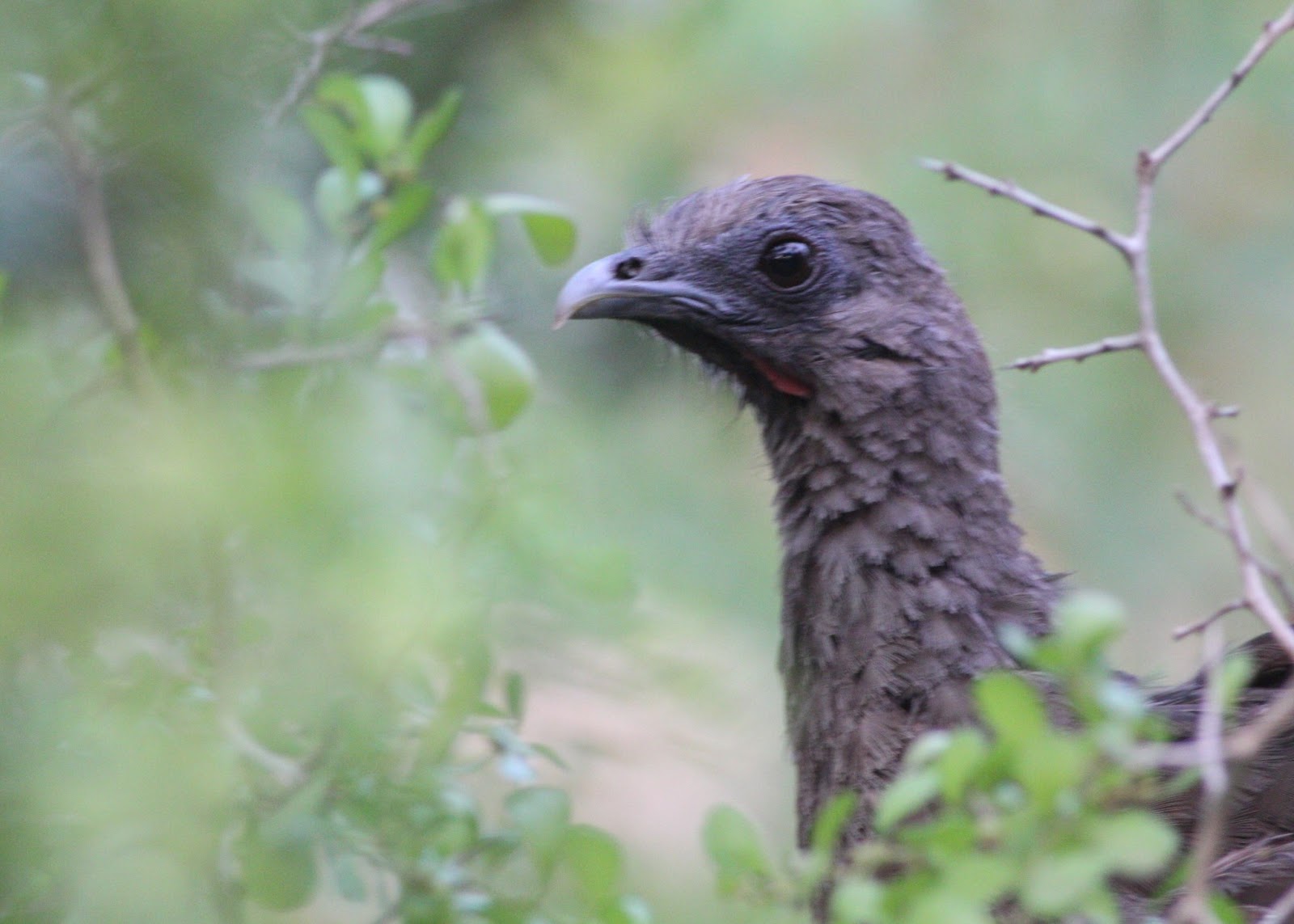
Although summer is arguably the worst time of year to visit here, we still came across a number of excellent birds.  Around the visitor center, for example, there were a number of parties of feeding Plain Chachalacas...


Plain Chachalaca
Surprisingly in the trees, we also saw many of the odd Black-bellied Whistling Ducks.  This one was only too happy to pose for a photo.


Sharing the trees with the ducks were birds such as Northern Cardinals, countless Golden-fronted Woodpeckers and Northern Mockingbirds, Green Jays, Olive Sparrows and Groove-billed Anis, 


Northern Cardinal
Green Jay
 In the undergrowth, we encountered Curve-billed and Long-billed Thrashers, Mourning, White-tipped, White-winged and Inca Doves, Ladderback Woodpeckers, an Altamira Oriole, and an interesting case of a Hooded Oriole (below) feeding a young Bronzed Cowbird.  The Cowbirds are notorious nest parasites, and in this instance, the Oriole believed the Cowbird was from its own brood.

Hooded Oriole 
 Under a bridge on the reserve, there were Cave Swallows, Purple Martins, Red-winged Blackbirds and a Black Phoebe, whilst on the wires were some more Gulf Coast Specialities - Scissor-tailed Flycatchers and Couch's Kingbirds.  On the visitor center feeding stations were Buff-bellied Hummingbirds.

Oh, hold on.  There's one more character that I've missed out....


Yep, that's right, Wily Coyote was in town.  Watch out Roadrunner.  
BUBO Listing www.bubo.org