Saturday, February 15, 2014

Strickland's Woodpecker

On a school trip to Nevado de Toluca, I managed to get half an hour birding in the evening around the campsite.  It did not disappoint, as I managed to catch up with a central Mexican endemic, the Strickland's Woodpecker.

Strickland's Woodpecker

Also in the pine-forest were Mexican Chickadees, Olive Warblers, Red Warbler, Brown-throated (House) Wren, Bluebirds (sp), Yellow-eyed Juncos and Striped Sparrows.  

Striped Sparrows

Red Warbler

Higher up on the slopes of the volcano were many Northern Ravens, more Striped Sparrows and Yellow-eyed Juncos, 1 American Kestrel and a Peregrine.  

Monarchs - Valle de Bravo

Great trip over the long weekend to see the Monarchs wintering in central Mexico.  We saw them at the Piedra Herrada reserve near Valle de Bravo, about a 3-hour drive from Tequisquiapan.  Recommend getting there first thing in the morning to enjoy this spectacle undisturbed.  We arrived at the reserve about 8.30, and were the first tourists.


You have to see it to believe it, really.

Great cast of birds in the woods as well, including White-eared Hummingbird, Green Violet-ear, Clay-colored Robin, Golden-crowned Kinglet, Mexican Jay, Red Warbler, Golden-browed Warbler, Crescent-chested Warbler, Hermit Warbler, Townsend's Warbler and Pine Siskin.


In Valle de Bravo itself, some nice birds at La Pena.  A flock of White-throated Swifts, Vaux's Swifts and Chestnut-collared Swifts and also Black Vulture and Cliff Swallow up there.


Wednesday, January 29, 2014

Military Macaws at Sotano del Barro

A trip to Sotano del barro in the Sierra Gorda is not to be missed.  To access this birding hotspot, you need to take a dirt track for 25km to the small village of Santa Mario de Cocos.  From here, you are up at 4a.m. to climb the 5km track up to the Sotano before dawn.  I recommend horseback on the way up, and walking on the way down.

Despite the pain of the never-ending night hike, all is worth it as you arrive at the lip of the Sotano, which at over 500m deep, is the second largest sink-hole in the World.  As the sky begins to get lighter, the excitement and mystery grows.  Then,  suddenly at about 6.45, a crescendo of raucous screeching fills the Sotano.  You look down into the abyss and pairs of huge, colourful Military Macaws are waking up.


Military Macaws

For the next hour, the Macaws fly round in pairs, giving great views, especially as the sun lights up proceedings.  Other birds in the Sotano include Canyon Wren, Brown-backed Solitaire, White-throated Swifts and Magnificent Hummingbird.   Bat Falcon keep an eye on proceedings.

Bat Falcon

The Sotano is a great place to visit.  It houses the only colony of Macaws in Queretaro - and is of great importance to this species which is in danger of extinction.   The views are worth going for as well, and any visit helps the locals in the Sierra Gorda.  

Monday, January 13, 2014

Presa Centenario, Tequisquiapan

Some decent birds around La Presa yesterday morning, as it continues to battle the Water Hyacinth.  On the open patches of water were plenty of ducks (particularly at the western end), including 3 Bufflehead, 1 Ring-necked Duck, 1 Lesser Scaup and good numbers of Gadwall and American Wigeon.  As usual, plenty of Eared Grebes, and also 4 Least Grebes.  


Male Bufflehead with Eared Grebe and Ruddy Duck

Eared Grebe
 Even better were 9 American White Pelicans  and upwards of a dozen Neotropic Cormorants.  Might well be a few fish knocking around finally.

Raptors are great at the 'far end'.  Here, I had juvenile Red-shouldered Hawk, a stonking Peregrine and also Turkey Vultures, Red-tailed Hawks, American Kestrel and a Cooper's Hawk.

In the scrub, 10 Curve-billed Thrashers, 9 Loggerhead Shrikes, 9 Golden-fronted Woodpeckers, 5 Blue Grosbeaks, 1 Grey Flycatcher (my first for a while).  Good numbers of Marsh Wren and Common Yellowthroat were also found.

74 species all in all.


Grey Flycatcher

Inca Dove

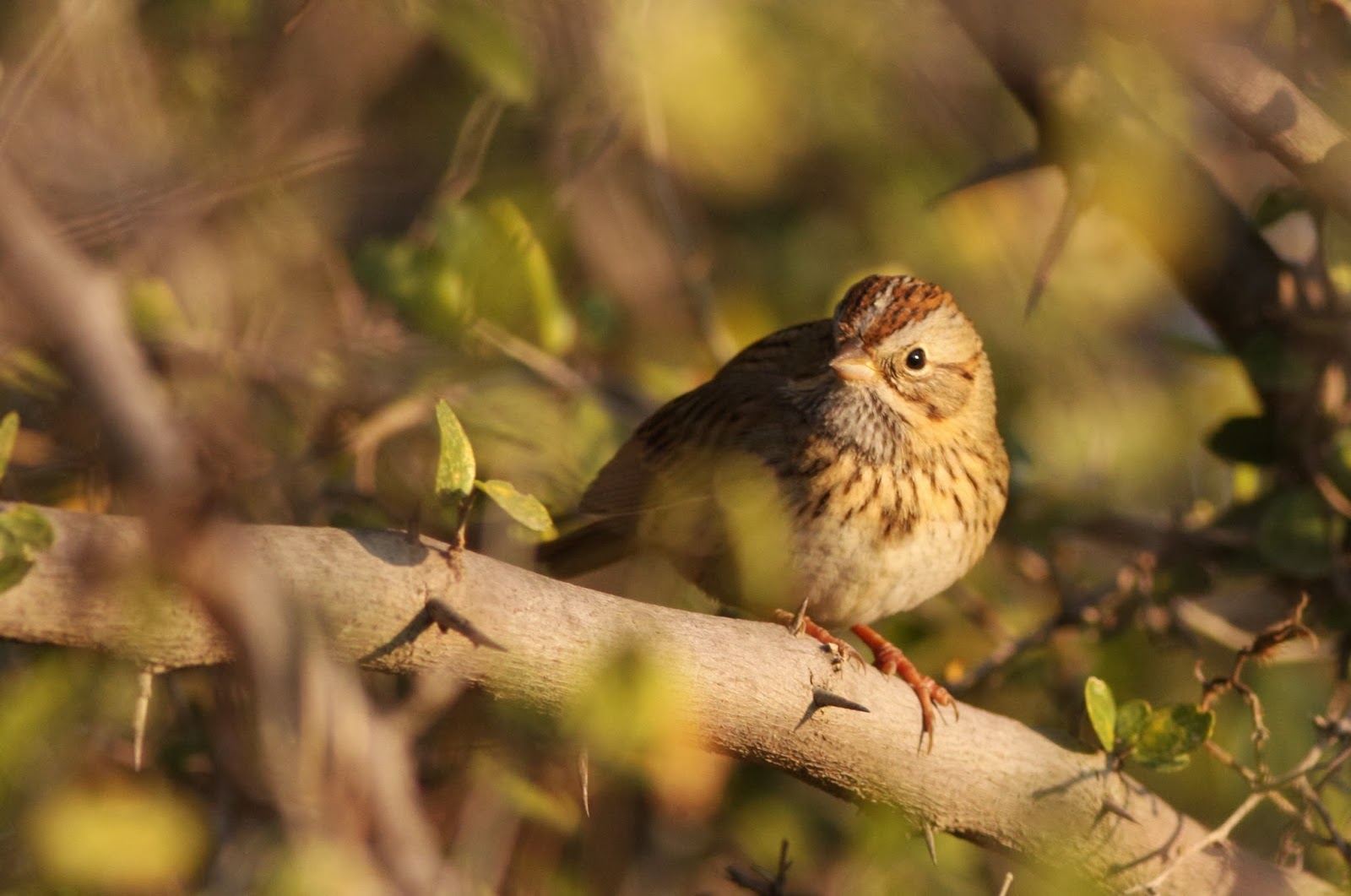
Lincoln's Sparrow

Friday, January 10, 2014

Birding Oaxaca

A few days holidaying around Oaxaca at the beginning of January presented a few birding opportunities.  Below are some of the pics I took and species I saw.

Oaxaca was a haven for wood-warblers, many allowing excellent views:

Black-and-White Warbler

MacGillivray'sWarbler

Red Warbler

Rufous-capped Warbler

Townsend's Warbler
As well as the above lot, there were plenty of Nasville and Audubon's Warblers, as well as Hermit, Wilson's, Crescent-chested, Olive, Wilson's and Black-throated Grey Warblers.  In abundance also were other migrants such as Tanagers (Summer and Western) and Orioles (Bullock's, Baltimore, Orchard).

More specialist birds came in the form of endemic species Grey-breasted Woodpecker, White-throated Towhee, Dusky Hummingbird and Bridled Sparrow (all found in the area around La Villada hostel), and Grey-barred Wren and Ocellated Thrasher, which were staked out with the help of Eric Antonio Martinez in the La Cumbre area, where we also saw Hairy Woodpecker, Mexican Chickadee, Hutton's Vireo and caught glimpses of the elusive Dward Jay among others.

Grey-breasted Woodpecker

Ocellated Thasher
Oaxaca is good for a trip combining birding with other activities, such as visiting the beautiful Monte Alban ruins.  As well as seeing unbelievable views...you can keep your eyes open for birds such as Rock Wren, Hermit Thrushand Canyon Wren as well as mixed flocks of Warblers, Vireos, Tanagers and Orioles, and hummingbirds such as Dusky, Rufous,  Ruby-throated and Berryline (as well as others in season).

Monte Alban ruins


Hermit Thursh


Turkey Vulture


Rock Wren


Full list and site details to follow.

Saturday, December 21, 2013

Another Anhinga

A late report from a birding trip two Sundays ago with Rosalinda Paez from Queretaro and JP Murphy from Ireland.  

We had a good walk around Presa Centenario - all the way from the dam to where the Rio San Juan joins the highway between San Nicolas and Bordo Blanco.  Plenty of raptors made for interesting viewing...as well as American Kestrel, Red-tailed Hawk and a stunning male Northern Harrier, we were treated to good views of this Turkey Vulture and more impressively, only my second ever Red-shouldered Hawk in Queretaro. 


Ugly Vulture

Red-shouldered Hawk

The best bird of the day, though, was surely this Anhinga.  Two in two weeks?  A mini-invasion perhaps, or more likely the same one as we saw at Presa Constitucion.  Here it is.  Same type of tree, same pose as the last one.

Anhinga...bird of the day

Another interesting sighting was two Neotropic Cormorant nests complete with youngsters.  The first breeding pairs I have seen here, although there must be others around.  This was pleasant news against the rather grim backdrop of a huge Water Hyacinth invasion, which is taking hold of the chain of reservoirs.  Fingers crossed that this weed is stopped somehow.

Other nice sightings around the Reservoir included prolonged views of Curve-billed Thrashers.


Curve-billed Thrasher

As well as a lot of Mexican Sister butterflies attracted to a pile of rotting Oranges..

Mexican Sister
 Good walk, good company, and a good time had by all.


Wednesday, December 18, 2013

Golden Eagle in Tequisquiapan, Queretaro

While climbing the Cerro Grande on Sunday with Valentina, Ernesto, and Russ and Carol from Texas, we encountered some great wildlife, with the undoubted highlight being views of a distant Golden Eagle from the top. 

Adult Golden Eagle
These majestic birds are rare across much of the range, and the same is the case in Queretaro.  We were all very lucky to witness one within walking distance of Tequisquiapan.

It soared into view whilst we were watching Red-tailed Hawks, Turkey Vultures and Ravens.  
Red-tailed Hawk
The birding is always good up the Cerro Grande - the habitats change with the altitude, bringing different bird species from down lower in Tequis.  Birds such as this Spotted Towhee illustrate this.   


Spotted Towhee
 We didn't explore the woods at the top (too tired after the hike up!), but a bit of pishing brought this Hermit Warbler close (note unstreaked flank), as well as some Ruby-crowned Kinglets, Orange-crowned Warblers and Yellow-rumped Warblers.

Hermit Warbler
 The Hummingbirds are different up at the Cerro as well.  Down in Tequisquiapan, we only see Violet-crowned and Broad-billed, whereas up here I've seen Lucifer, White-eared and Magnificent.  On Sunday, the migrant Rufous Hummingbird was added to that list (after much book consultation).


Other interesting birds that we saw were Scott's Oriole, Chipping Sparrow, Lark Sparrow, Clay-colored Sparrow, White-throated Swift, Say's Phoebe, Ash-throated Flycatcher and Ladderback Woodpecker.

BUBO Listing www.bubo.org