An early morning stroll along the Rio San Juan yesterday morning was rewarded with 56 species in good numbers.
I had a good nuber of raptors hunting above and around the river (Red-shouldered Hawk, Red-tailed Hawk, Sharp-shinned Hawk, American Kestrels, Crested Caracaras).
As usual, many, many warblers (70+ Yellow-rumped Warblers, and then a nice mixed flock including Black-and-white, Nashville, Orange-crowned and several Wilsons).
It was also good to pick up Greater Pewee, Blue Mockingbird, Great Kiskadee, many Black-backed Orioles, and good numbers of Woodpeckers (22 Golden-fronted, 1 Ladderback and 4 Yellow-bellied Sapsuckers).
Showing posts with label birds. Show all posts
Showing posts with label birds. Show all posts
Sunday, November 29, 2015

Wednesday, November 25, 2015
Great Horned Owl in Fuentezuelas
 |
| Great Horned Owl |
In the same area, I had fleeting views of an Elegant Trogon, as well as the endemic Blue Mockingbird and several Northern Mockingbirds. A Warbling Vireo was a nice addition, as well as a surprise Hermit Thrush (odd in this habitat away from forests).
A bit higher up, this area opens into grasslands interspersed with cacti. Here, I found a few Brewer's Sparrows, as well as Vesper, Chipping, Clay-colored and Lark.
At dusk, there were also a few Lesser Nighthawk.
 |
| Curve-billed Thrasher |
 |
| Warbling Vireo |
Tuesday, November 17, 2015
Presa Jalpan
I had a few visits this weekend to Presa Jalpan, in the heart of the Sierra Gorda. It's a pleasant spot, and a great place to catch up some birds typical of Tropical Deciduous habitat.
I was fairly surprised to see a Bufflehead on the Presa, in a mixed flock of duck (also present were Ring-necked Ducks, Redheads, American Wigeons, 1 Northern Pintail, Green-winged, Blue-winged Teals and Ruddy Ducks). Pied-billed Grebes, Least Grebes, Eared Grebes and Neotropic Cormorants were knocking around as well.
In the scrub around the Presa and uptowards Rio Adentro, I bumped into 1 Elegant Trogon, Northern Cardinal, Eastern Phoebes, Golden-crowned Warblers, White-eyed Vireo, Brown-backed Solitaires, Ash-throated Flycatchers, Boat-billed Flycatchers, Great Kiskadees, Social Flycatchers, Spot-breasted Wrens etc etc (full list for both trips below).
Full Species List over 2 visits
American Wigeon 4
Blue-winged Teal 5
Northern Pintail 1
Ring-necked Duck 4
Bufflehead 1
Ruddy Duck 3
Pied-billed Grebe 5
Eared Grebe 5
Neotropic Cormorant 4
Great Blue Heron 2
Snowy Egret 1
Cattle Egret 2
Turkey Vulture 6
Spotted Sandpiper 1
Eurasian Collared-Dove 1
Vaux's Swift 100
Elegant Trogon 1
Green Kingfisher 1
Great Kiskadee 4
Social Flycatcher 8
Couch's Kingbird 3
White-eyed Vireo 1
Common Raven 2
Northern Rough-winged Swallow 40
Canyon Wren 3
Spot-breasted Wren 4
Blue-gray Gnatcatcher 5
Ruby-crowned Kinglet 2
Brown-backed Solitaire 3
Blue Mockingbird 6
Gray Catbird 1
Nashville Warbler 2
MacGillivray's Warbler 2
Townsend's Warbler 1
Hermit Warbler 1
Rufous-capped Warbler 14
Golden-crowned Warbler 1
Wilson's Warbler 6
Blue-gray Tanager 1
Olive Sparrow 1
Flame-colored Tanager 1
Yellow-throated Euphonia 2
Gadwall 3
Green-winged Teal 6
Redhead 2
Least Grebe 3
Roadside Hawk 1
White-tipped Dove 2
Broad-billed Hummingbird 3
Golden-fronted Woodpecker 1
Eastern Phoebe 2
Vermilion Flycatcher 1
Dusky-capped Flycatcher 1
Ash-throated Flycatcher 1
Great Kiskadee 2
Barn Swallow 20
Black-crested Titmouse 4
House Wren 2
Ruby-crowned Kinglet 1
Orange-crowned Warbler 1
Northern Cardinal 1
I was fairly surprised to see a Bufflehead on the Presa, in a mixed flock of duck (also present were Ring-necked Ducks, Redheads, American Wigeons, 1 Northern Pintail, Green-winged, Blue-winged Teals and Ruddy Ducks). Pied-billed Grebes, Least Grebes, Eared Grebes and Neotropic Cormorants were knocking around as well.
In the scrub around the Presa and uptowards Rio Adentro, I bumped into 1 Elegant Trogon, Northern Cardinal, Eastern Phoebes, Golden-crowned Warblers, White-eyed Vireo, Brown-backed Solitaires, Ash-throated Flycatchers, Boat-billed Flycatchers, Great Kiskadees, Social Flycatchers, Spot-breasted Wrens etc etc (full list for both trips below).
 |
| Eastern Phoebe |
American Wigeon 4
Blue-winged Teal 5
Northern Pintail 1
Ring-necked Duck 4
Bufflehead 1
Ruddy Duck 3
Pied-billed Grebe 5
Eared Grebe 5
Neotropic Cormorant 4
Great Blue Heron 2
Snowy Egret 1
Cattle Egret 2
Turkey Vulture 6
Spotted Sandpiper 1
Eurasian Collared-Dove 1
Vaux's Swift 100
Elegant Trogon 1
Green Kingfisher 1
Great Kiskadee 4
Social Flycatcher 8
Couch's Kingbird 3
White-eyed Vireo 1
Common Raven 2
Northern Rough-winged Swallow 40
Canyon Wren 3
Spot-breasted Wren 4
Blue-gray Gnatcatcher 5
Ruby-crowned Kinglet 2
Brown-backed Solitaire 3
Blue Mockingbird 6
Gray Catbird 1
Nashville Warbler 2
MacGillivray's Warbler 2
Townsend's Warbler 1
Hermit Warbler 1
Rufous-capped Warbler 14
Golden-crowned Warbler 1
Wilson's Warbler 6
Blue-gray Tanager 1
Olive Sparrow 1
Flame-colored Tanager 1
Yellow-throated Euphonia 2
Gadwall 3
Green-winged Teal 6
Redhead 2
Least Grebe 3
Roadside Hawk 1
White-tipped Dove 2
Broad-billed Hummingbird 3
Golden-fronted Woodpecker 1
Eastern Phoebe 2
Vermilion Flycatcher 1
Dusky-capped Flycatcher 1
Ash-throated Flycatcher 1
Great Kiskadee 2
Barn Swallow 20
Black-crested Titmouse 4
House Wren 2
Ruby-crowned Kinglet 1
Orange-crowned Warbler 1
Northern Cardinal 1
La Trinidad Opal Mines Tequisquiapan
I had a very long walk up to the Opal Mines near Tequisquiapan last week. This is a popular tourist attraction and the road up goes through some interesting cactus-dominated habitat. Unfortunately, the weather was poor when I went. Nevertheless, I found some good birds, particularly at the top when it brightened up a bit.
It's the closest to Tequis that I have found Rock Wrens. Spotted Towhees, White-throated Swifts, Blue Mockingbirds, Scott's Orioles and 2 Lucifer Hummingbirds were also very nice to see.
Ash-throated Flycatcher is fairly easy to see around Tequis, but the 10 I found up at La Trinidad represents a good number.
 |
| Blue-grey Gnatcatcher |
Ash-throated Flycatcher is fairly easy to see around Tequis, but the 10 I found up at La Trinidad represents a good number.
Thursday, November 5, 2015
Elegant Trogon!
Despite all of the good birds I've seen recently around Tequisquiapan, today brought a new high - a magnificent male Elegant Trogon in the mountains above Fuentezuelas. I found this bird putting on a show in some tall trees at the base of a cliff over a small stream.
Over the course of a 3 hour walk throughout this undisturbed part of Queretaro, I bumped into other fantastic species. The Trogon was sharing the cliff face with Northern Cardinals, many Northern Mockingbirds, Phainopeplas, and a nice selection of Warblers including Virginia's, McGillivray's, Nashville and Black-throated Grey.
In the more scrubby parts of the walk, I found another many Scott's Orioles, Grey Flycatchers and lots and lots of Sparrows (Brewer's, Chipping, Clay-colored, Lark, Vesper, Lincoln's, Canyon Towhees and another Green-tailed Towhee).
50 species in total. Definitely be returning soon.
 |
| Elegant Trogon |
 |
| Elegant Trogon |
Over the course of a 3 hour walk throughout this undisturbed part of Queretaro, I bumped into other fantastic species. The Trogon was sharing the cliff face with Northern Cardinals, many Northern Mockingbirds, Phainopeplas, and a nice selection of Warblers including Virginia's, McGillivray's, Nashville and Black-throated Grey.
 |
| Northern Cardinal (male) |
 |
| Virginia's Warbler |
In the more scrubby parts of the walk, I found another many Scott's Orioles, Grey Flycatchers and lots and lots of Sparrows (Brewer's, Chipping, Clay-colored, Lark, Vesper, Lincoln's, Canyon Towhees and another Green-tailed Towhee).
50 species in total. Definitely be returning soon.
Tuesday, November 3, 2015
Fancy a brew?
It was Sparrow-tastic on the outskirts of Tequis yesterday, where I found a nice bit of scrubland.
The pick - my first Brewer's Sparrows. But they certainly weren't alone. Also knocking about in a short stretch were Grasshopper Sparrows, loads of Vesper Sparrows, Lark Sparrows and Clay-colored Sparrows.
It was arguably even better a day before when I found a cheeky Pyrrhuloxia. Only the second 'Desert Cardinal' I've seen, and certainly the first in this part of Queretaro.
The pick - my first Brewer's Sparrows. But they certainly weren't alone. Also knocking about in a short stretch were Grasshopper Sparrows, loads of Vesper Sparrows, Lark Sparrows and Clay-colored Sparrows.
 |
| Clay-colored Sparrow |
 |
| Brewer's Sparrow |
 |
| Vesper Sparrow |
It was arguably even better a day before when I found a cheeky Pyrrhuloxia. Only the second 'Desert Cardinal' I've seen, and certainly the first in this part of Queretaro.
Sunday, November 1, 2015
Rio San Juan - The new River of Raptors?
Left my house this morning to see a big raptor circling in the distance over the Rio San Juan. Didn't quite look right for the commoner species, so I dashed back to get my bins and camera and drove down to explore further.
I straight away locked onto a couple of raptors - Crested Caracaras perched high up. Great birds, but not top draw. Next an American Kestrel mobbing the Caracaras. Again, not bad.
Lower down in the same tree, though, was the original raptor - showing well and confirming my initial thoughts of Common Black Hawk.
I straight away locked onto a couple of raptors - Crested Caracaras perched high up. Great birds, but not top draw. Next an American Kestrel mobbing the Caracaras. Again, not bad.
Lower down in the same tree, though, was the original raptor - showing well and confirming my initial thoughts of Common Black Hawk.
 |
| Common Black Hawk |
An exceptional bird for this part of Queretaro. While there are a few plateau records, this species is primarily a bird of the slopes and lowlands - where it is commonly found along rivers and lakes.
Things got even better when another raptor started mobbing the Black Hawk - a fine juvenile Red-shouldered Hawk.
 |
| Red-shouldered Hawk |
Another rarish species here, though probably fairly regular in winter. I've previously seen a couple at Centenario. This species hunts along rivers and swamps. After buzzing the Black Hawk, it perched up getting mobbed in turn by the angry American Kestrel.
My species list along the Rio San Juan is now up to 122. These exceptional raptors go to the top of that list, alongside the likes of Broad-winged Hawk and Dickcissel.
Tuesday, September 18, 2012
The Two Presas
I showed two representatives of DUMAC (http://www.dumac.org/dumac/habitat/esp/index.htm), a wetland conservation body, around Presas Centenario and Constitucion on Saturday and we had a bumper day, clocking up some huge flocks of ducks, waders and herons, and some really unexpected birds along the way.
The highlights were as follows:
1. Hooded Merganser - This duck is an accidental visitor to Northern Mexico, so we were very excited to find a female at Presa de la Constitucion. Unfortunately, it stayed in cover for most of the time, so we couldn't photograph it. However, this is a superb record for Queretaro.
2. Black-bellied Whistling Duck - Considered common and widespread across both slopes in Mexico, Queretaro is our of range for this duck according to the map in Howell and Webb. Nevertheless, both species of Whistling Duck are renowned for being nomadic. We found a nice pair at Constitucion.

3. Tricolored Heron - A winter visitor across parts of Central Mexico and recorded once by Pineda-Lopez and Arrelaon-Sannaphre (2010). The individual we saw at Constitucion, however, represented my first sighting of this elegant heron in Queretaro.

4. Black Tern - We had three American Black Terns passing high over Constitucion. Following my sighting at Centenario (Hiley 2012), this is apparently only the second documented record of this migratory marsh tern.
5. Long-billed Curlew - This juvenile Long-billed Curlew was at the far end of Presa Centenario, associating with American Avocets and Black-necked Stilts. This is the first documented record of this species for the state of Queretaro.

6. Green Kingfisher - A fly by Green Kingfisher at Constitucion was an interesting record in as far as it confirmed (along with the presence of Cormorants and Pelicans) that Constitucion is a clean, fish-filled reservoir. Also, my first sighting of any Kingfisher away from the Sierra Gorda in Queretaro.
Full list to follow.
The highlights were as follows:
1. Hooded Merganser - This duck is an accidental visitor to Northern Mexico, so we were very excited to find a female at Presa de la Constitucion. Unfortunately, it stayed in cover for most of the time, so we couldn't photograph it. However, this is a superb record for Queretaro.
2. Black-bellied Whistling Duck - Considered common and widespread across both slopes in Mexico, Queretaro is our of range for this duck according to the map in Howell and Webb. Nevertheless, both species of Whistling Duck are renowned for being nomadic. We found a nice pair at Constitucion.

3. Tricolored Heron - A winter visitor across parts of Central Mexico and recorded once by Pineda-Lopez and Arrelaon-Sannaphre (2010). The individual we saw at Constitucion, however, represented my first sighting of this elegant heron in Queretaro.

4. Black Tern - We had three American Black Terns passing high over Constitucion. Following my sighting at Centenario (Hiley 2012), this is apparently only the second documented record of this migratory marsh tern.
5. Long-billed Curlew - This juvenile Long-billed Curlew was at the far end of Presa Centenario, associating with American Avocets and Black-necked Stilts. This is the first documented record of this species for the state of Queretaro.

6. Green Kingfisher - A fly by Green Kingfisher at Constitucion was an interesting record in as far as it confirmed (along with the presence of Cormorants and Pelicans) that Constitucion is a clean, fish-filled reservoir. Also, my first sighting of any Kingfisher away from the Sierra Gorda in Queretaro.
Full list to follow.
La Laja, Fuentesuelas
I checked out Fuentesuelas on Thursday night, primarily to see if there were any waders around ahead of the visit from DUMAC. I found, however, that the water level here was very high, thus making it difficult to access, and meaning that there were few exposed banks for waders to feed on. Nevertheless, there were a good array of impressive birds here.
 |
| Female Ruddy Duck and duckling |
On the wader front, there were approximately 500 Wilson's Phalaropes feeding in very tight groups in each corner of the lake. Also, the ever-present Killdeers, and a handful of Yellowlegs sp., and Black-necked Stilts on the far shore.
Raptors included Crested Caracara and Northern Harrier, and passerines included Vermilion Flycatchers, Blue Grosbeaks and Lesser Goldfinch.
 |
| Male Vermilion Flycatcher, Fuentesuelas |
Tuesday, September 11, 2012
Presa de la Constitucion - San Gil
I had an absolute MEGA morning at this reservoir near San Juan del Rio today. Presa de la Constitucion has the advantage of being up river from the factories of industrial San Juan, and so its waters are significantly cleaner and full of fish than many others in Queretaro. Furthermore, it has a good combination of deep water, muddy exposed shores and well-vegetated marshland. This myriad of habitats allows a greater variety of bird-life to thrive compared to Presa Centenario in Tequisquiapan, for example.
More surprising was just how many Great Blue Herons were present. At least 40 were present, including a group of 11 feeding together in the shallows and a couple more in nearby fields.
Three American White Pelicans loafing in the shallows were a pleasant bonus, as were the masses of Neotropic Cormorants. The presence of pescivores such as these two indicated that the Presa was full of fish..
Where to start? After a day in which I photographed 4 species new for the state of Queretaro? Best to split the birds of Constitucion into categories....
1. HERONS et al.
A group of 50 Black-crowned Night Herons on a feeding flight early in the morning pointed to local breeding. Also present in extremely large numbers were the '3 white egrets'. There were huge numbers of Cattle (200+), scattered Snowy Egrets (20+) and over 50 Great Egrets..
 |
| Great Egret |
 |
| Great Blue Heron |
 |
| Great Blue Heron |
 |
| American White Pelicans and Neotropic Cormorant |
There were a few groups of White-faced Ibis present as well, but best of all was this 1st year ROSEATE SPOONBILL seen here with a large group of Cormorants. Roseates are strictly coastal birds in Mexico, with very few inland records. This young bird is a long way from where it should be.
 |
| Neotropic Cormorants and ROSEATE SPOONBILL |
 |
| Roseate Spoonbill close up |
To follow...Swallow Spectacle, Ducks and Waders and Passerines!
Tuesday, May 3, 2011
YUCATAN April 2011 - Ux Mal
A cultural visit to the spectacular Mayan ruins at Ux Mal threw up some more birding opportunities.


We stayed in the nearby SACBE Bungalows, which are located in some great gardens. Needless to say, some campground birding yielded great results.
I was enjoying watching a variety of Orioles and some vocal Lemon Green Vireoes, when what was probably the bird of the trip scattered the lot, ghosting through the canopy and perching up in a tree. It was a Collared Forest Falcon, a bird which, whilst being easily heard, is notoriously difficult to see. Unfortunately, it scarpered before I could whip my camera out.
The car park of the Ux Mal ruins was alive with activity at dawn, including Blue-crowned Motmots, Melodious Blackbirds, Orange Orioles, Greyish and Black-throated Saltators, Clay-coloured Robins, Green and Yucatan Jays.
 Birds weren't the only wildlife at these ruins. Iguanas were everywhere, acting like they owned the place..
 It wasn't long, though, before my eyes were back to the skies, as a fine adult Crane Hawk drifted by. In the ruins themselves, Cave Swallows were nesting.

Up above the site, Cave Swallows, Barn Swallows and Purple Martins filled the skies.
 Birds weren't the only wildlife at these ruins. Iguanas were everywhere, acting like they owned the place..
 It wasn't long, though, before my eyes were back to the skies, as a fine adult Crane Hawk drifted by. In the ruins themselves, Cave Swallows were nesting.
Then, a glimpse of one of the most colourful of Mexico's birds, a Turqoise-browed Motmot, displaying its exquisite tail feathers...


Wednesday, December 22, 2010
Birding and Pyramiding
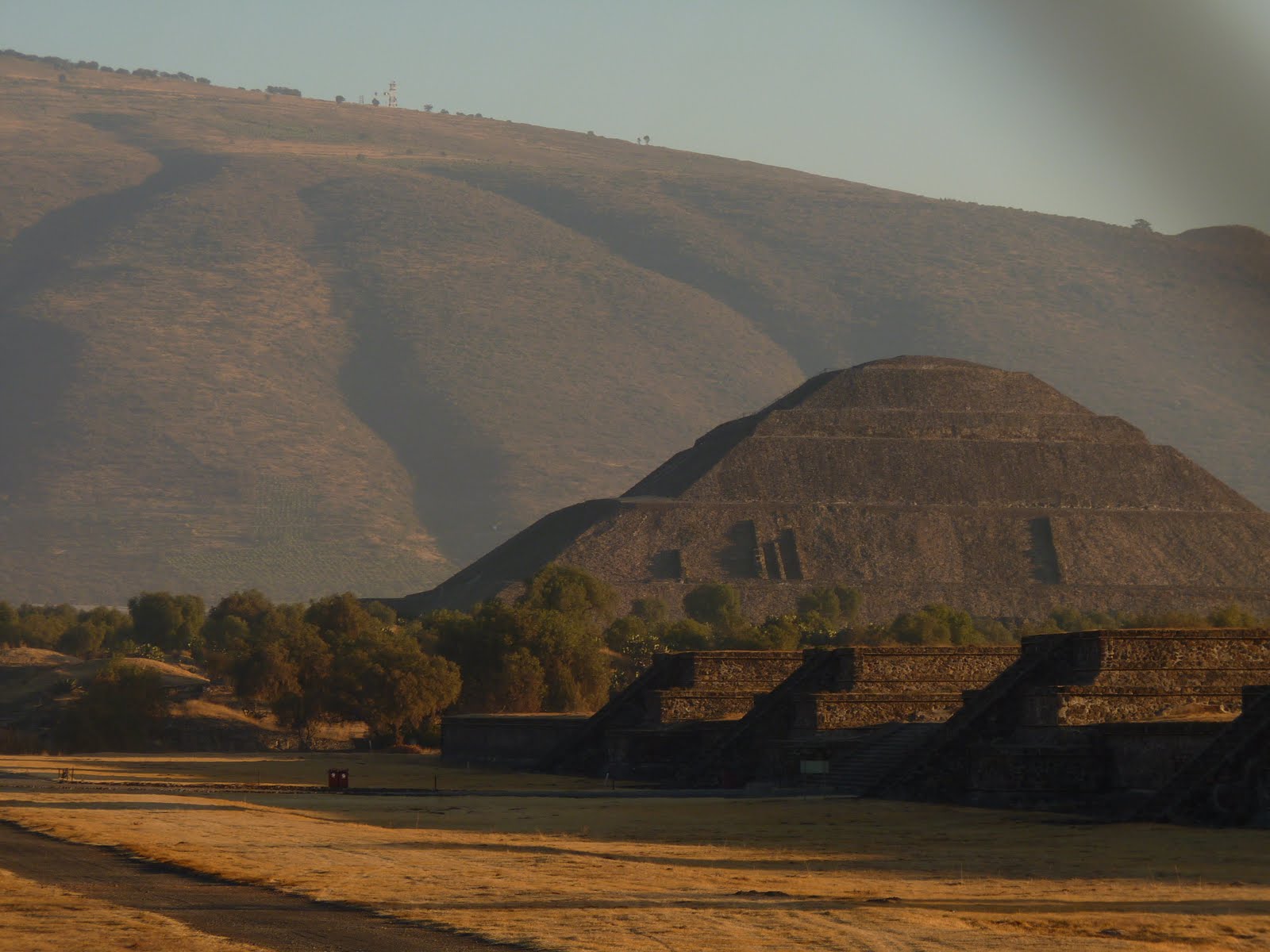
Been spending the day at the Teotihuican Pyramids today prior to flying out. Our hotel (Villas Arqueologicas) has some pretty nice gardens, so, needless to say, I had an explore at first light.
Some pishing brought me a nice selection of American Warblers - Yellow Rumped (Audubon's) by the dozen, 4 Wilson's Warblers, an Orange-crowned and a fine Townsend's. A Ruby-crowned Kinglet was also knocking around.
A few Curve-billed Thrashers thrashed on the lawn, and higher up in the trees I had Cassin's Kingbirds and a nice flock of Rufous-backed Robins.
 I couldn't resist snapping some Inca Doves.
Or this cheeky Bewick's Wren - one of 2 scuttling mouse-like along the tree trunks.

A Hammond's Flycatcher high up in the conifer provided me with another Empidomax headache, but that was soothed by good views of Mexican Ladder-backed Woodpecker and Bullock's Oriole.
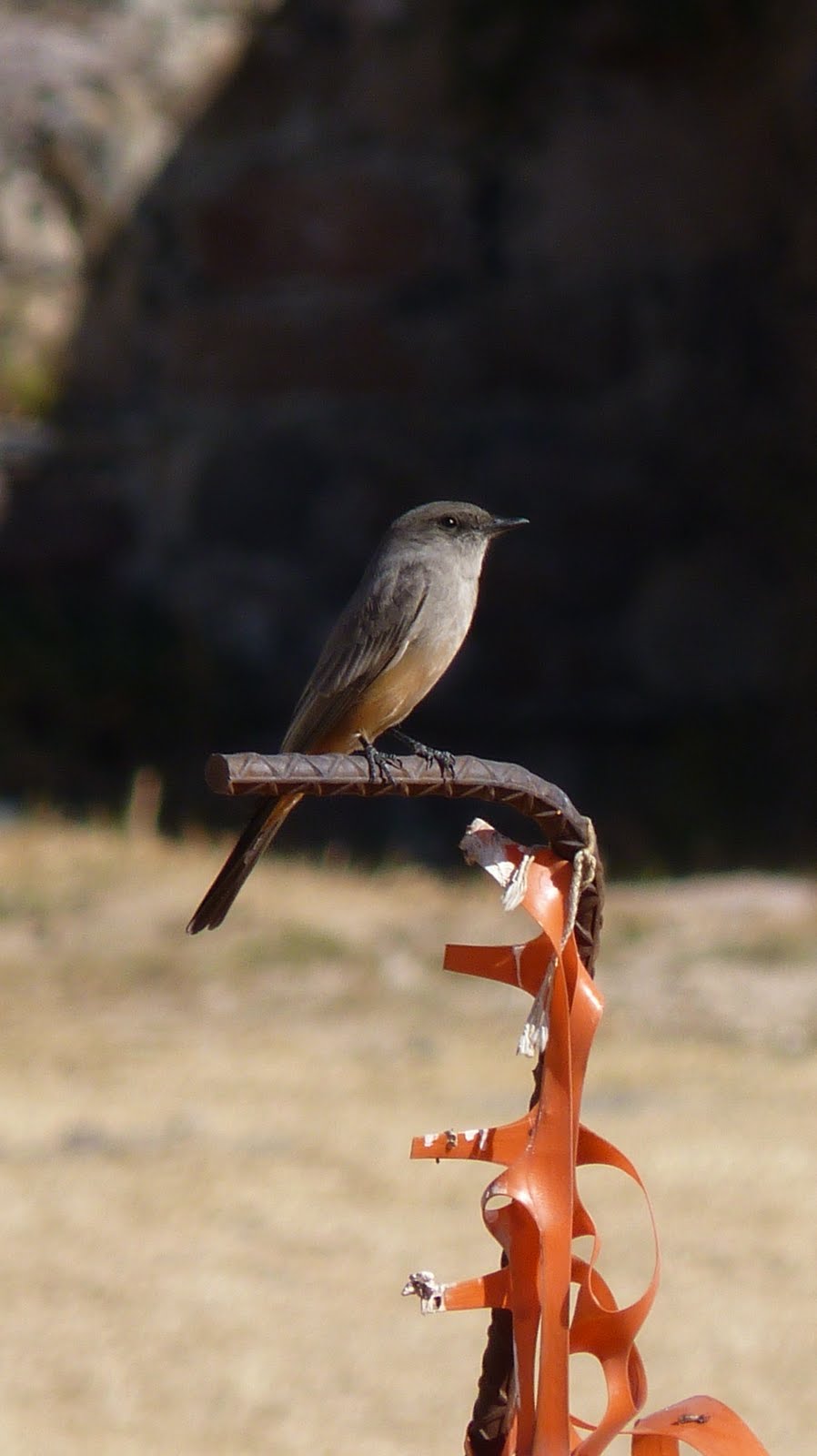
There wasn't a lot of bird activity around the pyramids themselves. Lark, House, Clay-coloured and Chipping Sparrows took some picking out in the long grass. Much more obliging were the numerous Canyon Towhees..

And this Say's Phoebe:
My last day's birding in Mexico before a little Christmas break in England. Future blog posts are set to include:
26th December - Wirral Boxing Day Bonanza
27th December - Peak District Bash
1st January - The Big Day
4th - 6th January - BENELUX
Returning to Mexico on the 7th January for more lifers and banter..
Subscribe to:
Posts (Atom)
